
When we’re drafting a story, our brains often try to get away with being lazy because writing with purpose and voice and imagination is hard. That laziness can also lead us to rely on stereotypes, clichés, and tropes.
We can’t avoid stereotypes all the time—after all, we each embody at least one stereotypical aspect, so avoiding them entirely wouldn’t feel realistic. However, sometimes our lazy brains will feed us those clichés because they’re stuck in ruts of default thinking and assumptions.
Default ruts and writing tics are a problem no matter their source or style. Every aspect of writing should be a conscious choice (if not during drafting, then during editing) to ensure our writing is as strong as it can be.
A common symptom of lazy writing craft is falling back on a “default” character, such as one who’s white, straight, and middle class. The problem with that default isn’t with the “lack” of diversity (as no one’s going to force us to write inclusively if we don’t want to). The problem is with the assumption, the laziness, the failure to consciously consider options.
One thing we can do to prevent that subconscious default from taking hold is to listen to our characters to ensure they feel three-dimensional, real, and natural. Taking that step might help us avoid the problem of “stock” or “default” characters (of any type).
But what if that step isn’t enough?
- What if we hear from different types of characters, but they still feel like they rely too much on stereotypes or assumptions to feel real?
- Or what if we want to include more diversity, but our lazy brains remain stuck in their assumption ruts?
We’re not alone. Our brains have come to rely on a default way of thinking over a lifetime of experiences, and it can take conscious questioning to expose our assumptions.
Luckily, Bran L. Ayres is here today to help us—and our brains—break out of the ruts of default thinking and assumptions. They’re also sharing two awesome resources:
- a questionnaire to help us develop our thought process to be more open to possibilities
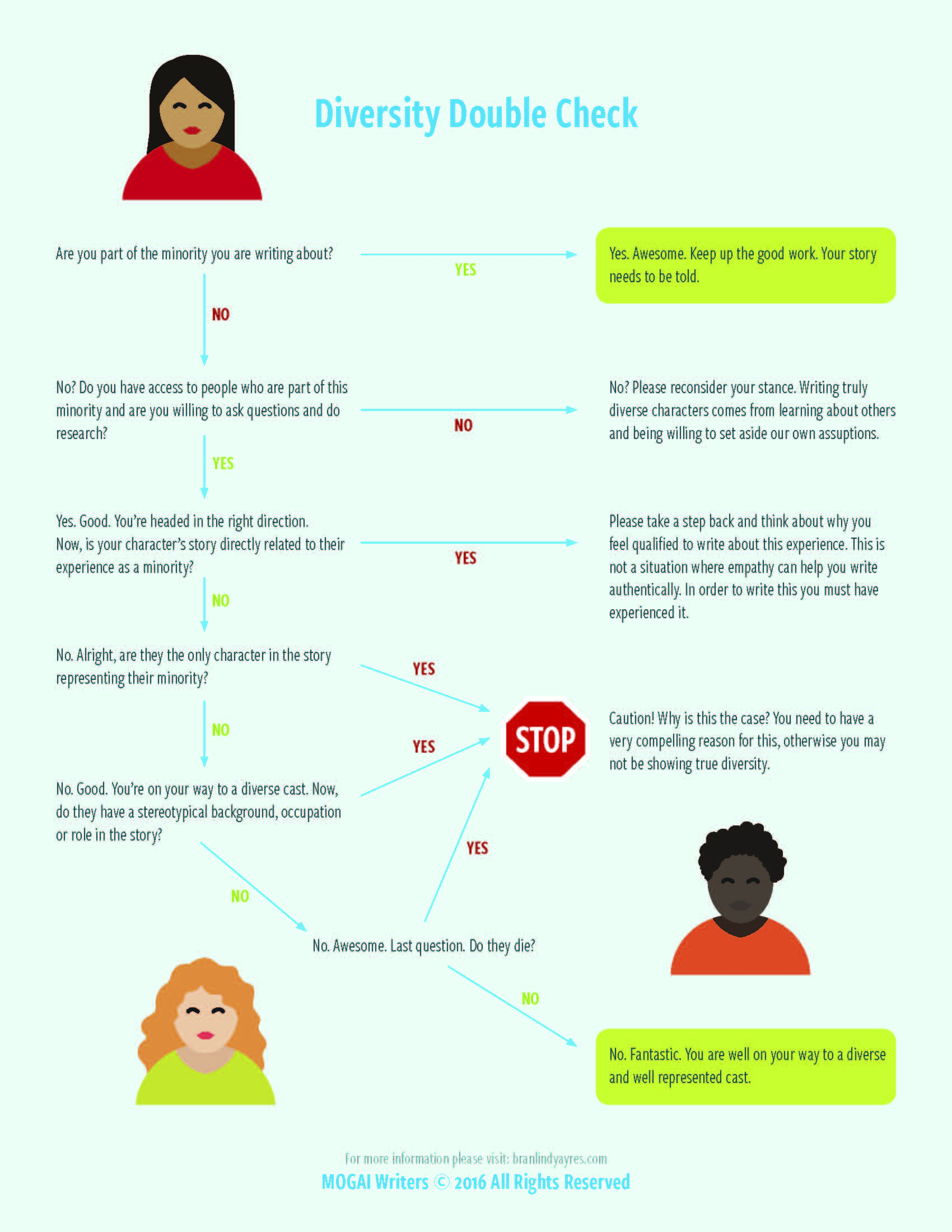
- a flowchart to help us avoid the pitfalls of stereotypes
Yay! Please welcome Bran L. Ayres! *smile*
*****
Overcoming Internalized Bias
by Bran L. Ayres
William Cowper’s poem, “The Task” (1785):
“Variety is the very spice of life, That gives it all its flavor.”
One of the biggest mistakes we make is assuming that other people think the way we think.
— Sonya Teclai (@SonyaTeclai) June 28, 2015
Whether we realize it or not, we all have internalized prejudices, things we’ve learned or been taught by parents, family, friends, and the media. These influences shape how we think and feel about events and people we encounter in our daily lives.
Some we might have grown out of or decided to leave behind, like learning to enjoy foods or activities we might have avoided when we were younger. Some prejudices or biases are a little more harmful than disliking broccoli or believing cats are the best pets.
Some are also more deeply ingrained and potentially much more damaging. It can take a lot of effort to first recognize and then overcome these.
But what does any of this have to do with our writing? Everything.
Our Writing Reflects Our Subconscious Beliefs
We often don’t realize it, but we bring all our internalized beliefs and prejudices to our writing. Even those of us who have striven to be inclusive and open minded in our writing still have underlying prejudices (and yes, being part of a minority doesn’t mean you’re free of these either).
These are what are called implicit associations. Things we don’t even consciously realize we believe. Many of these are rooted in stereotypes of other genders, races, sexual orientations, religions, and so on.
Our Harmful Beliefs Can Hurt Our Readers
Our writing can negatively affect our readers in ways we might not expect. We might not offend them, but we can accidentally end up reinforcing stereotypes and prejudices.
GoodTherapy.org under Prejudice/Discrimination says:
“Prejudice and discrimination may have far-reaching effects. People who believe that they are being judged negatively or who are treated as inferior may have difficulty performing to the best of their ability, especially if they experience prejudice or discrimination on an ongoing basis due to an intrinsic characteristic of who they are as a person. The discriminatory actions of others may also lead those affected by these assumptions and behaviors to develop physical or mental health problems as a result.”
Let’s illustrate how this can happen. Please read the following examples and then decide which you feel illustrate prejudice by an act of discrimination:
Example 1:
Matt and James are planning their wedding. Things are going smoothly until James visits their local bakery to order their wedding cake. The owner is very apologetic but refuses to make their cake on religious grounds.
Example 2:
Jose has applied to job after job yet cannot seem to get any return calls. He’s more than qualified, with several years of experience and a degree in his field. On a whim he changes his name on his CV to “Joe” and applies for yet another job. The very next day he is called in for an interview.
Example 3:
Christine has just recently started working for a new firm. She loves her job and is doing very well. Her colleagues like her and they work well together. She often finishes projects well before they are due. A new project comes up that falls within her skillset. She goes to her boss and asks if she can have the project and lead the group. Her boss, Elaine, thanks Christine for her initiative but explains that she’s not certain if Christine is quite ready to lead a group yet.
This was a bit of a trick question. They all show discrimination or bias in some fashion, some of it more subtly.
Don’t worry if you didn’t catch the subtle bias. It takes a lot of practice and deliberate mindfulness to recognize some of these, especially when it comes to our own writing.
Awareness Is the First Step
Even when we are actively trying to write diversely, it can be easy for us to fall prey to our own blind spots when it comes to characters. I personally often end up with villains who are straight, white and blond haired, something I never even realized I was doing until it was pointed out to me.
Our characters are different from us, so we can't rely on what we *think* we know. Click To TweetWe must remember that even in our own spheres of experience, we are not the sole representations of our race, gender, profession, et cetera. The same holds true of our characters, and especially of any we write whose backgrounds we don’t share.
It can be too easy to fall back on what we think we know about a particular race, orientation, gender, physical ability, religion, age and so on.
Stereotypes are often the default “generic” picture we are given, and many times they end up in our writing. Not because we are bad writers (or people), but because we are simply products of our upbringing and environment.
It is up to us to recognize our biases and challenge them. Especially as we strive for more inclusivity in our writing.
Use Awareness to Challenge Our Biases
However, just being aware isn’t enough. It is easy to recognize broader, well known stereotypes—men like sports, women like shopping, gay men are flamboyant—but it’s harder to spot things we’ve internalized, things we don’t even realize we are doing. This is when we need to take a step back from our writing and look closely at ourselves.
Awareness of biases is just Step 1 — then we have to *challenge* them. Click To TweetJust being aware of prejudices alone isn’t going to overcome the need to be mindful, do research, and hire sensitivity readers. You will need to establish goals and strategies to help you overcome internalized prejudices.
By deliberately working to be inclusive, you will find yourself with increased awareness of diversity related attitudes and behaviors. This isn’t something that will happen overnight. You will have to work at it.
Excuses that doing research or being more inclusive will stifle creativity are tantamount to saying “my personal opinion is more important than your existence.”
That may sound rather harsh, but as writers, we’ve taken on the task of representing life, and life is full of variety. To minimize that is putting on blinders and ignoring things that could make our stories that much richer.
As Oren Ashkenazi said in their article Eight Easy Steps for Writing Diverse Stories:
“If we can’t imagine diverse worlds in fiction,
how will we create one in real life?”
Ready to Write Inclusively? Where Do We Start?
So with all this advice on how to write inclusively, how do we know where to start?
Want to write inclusively and add diversity? Where do we start? Click To TweetIt can be daunting to look at our work and try to be more inclusive. We might feel as though we’re shoehorning characters into the story just for the sake of having them and that’s the last thing we want.
But where do you begin adding in diverse characters, and how can you avoid having them seem tacked on?
Next we’ll look at some questions to help you get started. You’re welcome to grab a pen and paper and jot things down as you read them. You might be surprised by the answers.
- How many minorities are represented in your story? List all your minority characters and their roles.
- Of those characters and their roles, which are stereotypical? (If you are uncertain, research common stereotypes.) List optional roles that break these stereotypes and which fit within your story and plot.
- If your list from question #1 revealed only a few minorities or none at all, list all your characters and their roles.
- Look at your list from #3 and pick which characters could be cast as a minority.
In a large cast, it is best to pick more than three to cast as minorities, to avoid tokenism. For smaller casts (7 or fewer) pick at least two characters, but be careful to avoid using stereotypes to characterize them.
If you feel this wouldn’t suit your story and plot remember: We are not here to force diversity, but to show its natural occurrence. A good example of this is highlighted in the Tumblr post by mybrainmadethis about the TV show Brooklyn 99.
Often the first thing that comes to our minds when writing minorities will be a stereotype. We are constantly bombarded with poor representations of minority groups and will need to actively work to refute those depictions.
Is It Really So Bad to Let Assumptions Lead Us?
Books like The Curious Incident of the Dog in the Night-Time by Mark Haddon can misconstrue and mislead readers into thinking they are true representations of people. While Haddon never claimed the book was about autism and spoke publicly against using his book as an example of how to relate to autistic people, he chose to write a character that in his words:
“If he were diagnosed, he would be diagnosed as having Asperger’s syndrome, which is a form of autism. I suppose you’d call it high-function autism in that he can function on, you know, a day-to-day basis, in a kind of rudimentary way.”
He added, “I have to say honestly that I did more research about the London Underground and the inside of Swindon Railway Station, where some of the novel takes place, than I did about Asperger’s syndrome. I gave him kind of nine or 10 rules that he would live his life by, and then I didn’t read any more about Asperger’s because I think there is no typical person who has Asperger’s syndrome, and they’re as large and diverse a group of people as any other group in society. And the important thing is that I did a lot of imagining, that I did a lot of putting myself into his shoes in trying to make him come alive as a human being rather than getting him right, whatever that might mean.”
(Gross, Terry (26 June 2003). “Interview: Mark Haddon Talks About His New Book, The Curious Incident of the Dog in the Night-Time“. NPR.)
“Whatever that might mean” is that by not “getting him right” Haddon both reinforced stereotypes, misled his readers and alienated actual autistics. His writing actively hurt and insulted autistics.
His refusal to do simple research led to a very skewed and completely inaccurate depiction of autism. He felt that his personal opinion of what makes someone “human” was more important than writing an actual autistic person.
We don’t want to make this mistake with our writing. Thankfully, it is very easily avoided by doing our research and being mindful, which are fundamental things all writers can and should do. As fundamental as proper spelling and punctuation.
(Note: You can read a critique of the book by an autistic person here.)
Writing Fully-Formed People Is Better
Let’s look at another example, this one an accurate representation of a trans woman in the show Sense8. Nomi Marks is a character on the popular TV show; she was born Michael Marks and is portrayed by Jamie Clayton.
In the show she is a political blogger and “hacktivist” who is engaged to her fiancée. She faces many challenges, including parents who do not accept her gender identity or her fiancée.
She is given a full life that doesn’t just revolve around being trans. She’s not coming out, and she’s not desperately seeking to transition.
Jae Alexis Lee, a transgender woman, says of Nomi:
“We’re seeing a trans woman living her life. For lots of us, life after transition doesn’t mean you stop being trans. … What I love most about Nomi though is that, while the fact that she’s trans remains part of the story, it is rarely center stage which lets her get on with being the truly badass hacker and team coordinator that she is. She isn’t a lens for the cisgender audience to look at trans issues through, she’s a trans woman that we, as trans women, can relate to.”
Writing inclusively with authenticity and compassion can lead to new readers. Click To TweetA lot of writers decide not to attempt to add any diversity to their stories out fear of getting it wrong. But this is easily overcome by researching, seeking out sensitivity readers, and simply challenging ourselves to do better.
We all want to be better writers, we want to connect with our readers and reach larger audiences. Being inclusive and doing so with authenticity and compassion has the potential to open up whole new readerships for us.
We must be willing to examine ourselves and face things that might be difficult. I promise you, it is worth it.
Questions to Help Us Overcome Implicit Biases
The following questions will help you start to overcome ingrained stereotypes or implicit associations you might have about minority characters you may already be writing.
Pick one of your existing minority characters to answer the following questions:
- What role does this person play in the story? Is the role the first one that came to mind? Is it a stereotype or does it reflect negatively on the minority (even so called positive stereotypes can be damaging by creating unrealistic expectations) as a group? If so, what changes can you make so that it is not a derogatory or unrealistic characterization of the minority?
- What is their backstory? Is this backstory something you feel people of this minority share? What led you to this conclusion? What other possibilities might exist?
- What job do they currently hold? Why did you pick this particular occupation for them? Is it something you think many people from this minority do for work? If so, why do you feel this way? What other jobs might this person have within the framework of your story?
With these few questions you’ll be on your way to a more inclusive story. As mybrainmadethis on Tumblr says:
“… if you don’t like token characters, the answer isn’t less diversity.
It’s more.”
Resources to Help Us Write Diversely and Inclusively
I’ve developed a worksheet to help you write more diversely without falling back on stereotypes or feeling as though you’re just filling a perceived quota. The following infographic is a shorthand version of the worksheet and is something I hope you’ll find both useful and educational.
Flowchart: Diversity Double Check
Graphic design by Eleonore Eder
Worksheet: Diversity Development Questionnaire
A link to the worksheet is also included below along with links for further reading and research resources. Please let me know if you find it helpful.
(Note from Jami: This worksheet contains all the questions in the bullet items throughout this post and builds on those ideas with more information and writing exercises.)
More References:
- writingbeyondtherainbow.com
- Why Subtle Bias Is So Often Worse than Blatant Discrimination
- 4 Tips for Writing Diverse Characters
- How Do You Write About “Diversity” When the Word Has Become Hollow? Three writers—Daniel José Older, Ashley Cassandra Ford, and Tanwi Nandini Islam—examine a word that’s lost its meaning.
- Writing Diversity: How Can We Avoid Issues?
- IAT: Implicit Association Test
- Going Over the Rainbow: The Diversity Dilemma
- Prejudice & Discrimination: Crash Course Psychology #39 YouTube
- Reasons Positive Stereotypes are not Positive
*****
 Growing up in rural Missouri surrounded by dense forests teeming with giants, dogwood horses, pine castles and grapevine snakes, Bran has always had a very healthy imagination. This was further inculcated by their mother, who encouraged them to read the likes of Ray Bradbury and Isaac Asimov. Their love of fantasy and writing has never waned even as they got older, and has developed into a need to write.
They currently live in Southern Missouri with three young nerdlings, an elderly dachshund, and three precocious felines. When not writing, Bran can be found with their face still glued to the computer screen playing video games or reading.
You can find Bran on their website, Twitter (@brohne), and Facebook
*****
About The Jeweled Dagger:
 A disgraced spy. A rookie captain. Trusting the wrong person will get them killed.
Orandon is poised for technological revolution, but the Kingdom hovers on the edge of bankruptcy. As spymaster, Lafayette helps the Queen negotiate the delicate balance of loyalties at Court. But his last mission was a failure. Now he is forced to work with the new Captain of the Queen’s Guard—a man he would happily murder. Instead, he must swallow his pride, follow the Queen’s orders and pray his mistakes haven’t doomed them all.
Captain Jasper Stanton is clueless. A week into a rank he knows he doesn’t deserve, he’s faced with the most infuriating—and captivating—person he’s ever met. Lafayette holds the key to finding a mysterious informant who could uncover the conspirators. But can Jasper gain Lafayette’s trust before the assassins strike?
Bursting with fast-paced action, smoldering romance and deadly court intrigues, this first installment of The Daggers of Ariyon series will have you up reading all night.
Get The Jeweled Dagger now and uncover the schemes at Court!
*****
Thank you, Bran! As I mentioned to you when I first saw it, that flowchart is a thing of beauty! *grin*
As Bran mentioned, this isn’t about forcing people to include characters from diverse backgrounds in our stories. Instead, this is about helping people who want to include diverse elements but don’t know how to change their thinking processes get away from those implicit associations and default assumptions.
We can all be so used to the “box” we live in every day that’s it’s hard for us to think “out of the box.” For those of us who want to explore the variety of our world in our stories, I’m grateful to Bran for their tools to help us improve our writing. *smile*
LAST DAY!
Want to write faster? Or finish NaNoWriMo?
Join Jami in a workshop to learn how to do just enough story development to write faster, even if we write by the seat of our pants.
Click here to learn more!
Have you ever thought about what your implicit biases might be (or have you already come face-to-face with one of your assumptions)? Does the knowledge that we all have subconscious beliefs make you feel relieved or worried about writing inclusively? Have you wanted to include diverse elements but weren’t sure where to start? Does Bran’s advice or tools help? Do you have any questions for Bran?
 wpDiscuz