
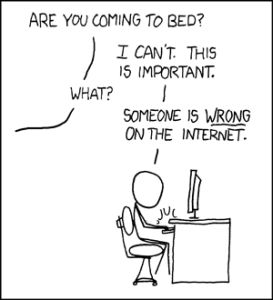
*sigh* It’s happened again. An author has insulted other authors and a huge percentage of readers. Why do people do this?
Between social media, the interrelationships of the publishing industry, and the permanent nature of the internet, news of negativity travels far and wide. Sure, we can’t spout unicorns and rainbows all the time, but I question someone’s goals when they fling insults.
If we act unprofessionally, we (surprise, surprise!) won’t be seen as professional. If we put down the majority of readers, we limit our readership. If we put down other authors, we negatively affect our ability to work with them—and all those associated with them.
Let’s not kid ourselves. No matter what publishing path we take, we need to work with others in the industry.
It’s shortsighted to put down authors who might be our agency-mates, share our publisher, use the same freelance editor (and by putting down an author’s work, doesn’t that reflect on their editor?), have the power to veto letting us into a “tribe” of indie/self-published authors, or any other of a hundred ways we’re all connected.
Yet people fail to learn the lesson from the last ten times this internal sniping went badly and want to discover the consequences for themselves.
An odd dichotomy exists within the internet, as it possesses both a short attention span and a long-term memory. This current issue will blow over, as it always does, but the next time someone makes a similar mistake, the details of this incident will be brought up again as an example. Maybe the example will point out how people don’t learn from the past, or how these arguments have been rehashed a billion times. The point is, the internet remembers, and this author will forever be held up as an example of “what not to do.”
One YA author insulted a genre years ago, and the co-author of a popular book review blog, while referencing a current issue, tweeted a link just last week to a several-year-old post exposing the author’s attitude. The blogger admitted that she still holds a grudge against the author for that behavior. Years later.
We might be able to understand someone’s negativity if they’re venting about a perceived wrong. We all do that. We all need to vent sometimes.
But in most of these cases, the insults come from nowhere. There’s no trigger, no revenge motivation, nothing. Just plain, “I’m going to put you down because it makes me feel superior.”
We know that behavior by another word: Bully.
I don’t care how jealous we are of other authors, other blogs, or other books. Someone will always receive more attention than we do. We cannot build ourselves up by tearing others down.
In this case, the author insulted…wait for it…the romance genre. *insert shocked face here* He states his opinion that romance authors shouldn’t be treated as well as other authors—and he states this as fact. He states as fact that romance novels are meant to be inferior.
In his twisted argument, any romance novels that are any good aren’t, in fact, romance novels, but love stories. Try telling the authors that.
But that’s how he justifies his insults. In his definition, good books can’t be romance novels because if they’re any good, he calls them something else. (Um, yeah, don’t try to make sense of that circular logic.)
Let’s skip over the insanity of that argument, let’s ignore the fact that the romance genre is ten times broader than the category romance stories he assumes it to consist of, and let’s gloss over the detail that he writes genre science fiction and thus can’t even use literary elitism as an excuse for his behavior.
Let’s just look at what could possibly motivate him to insult the largest percentage of genre readers. *think, think, think* Nope, I got nothing.
Romance readers read broadly. They read historical, literary, and yes, his genre of science fiction. *raises hand* Unlike his assumption of romance readers, I’m qualify-for-Mensa intelligent, I’ve read from Douglas Adams to Isaac Asimov (and that’s just in the “A” section of science fiction authors), and I care deeply about the quality of writing in books. Ask anyone I’ve beta read for. *smile*
And unlike his assumption that all romance readers are stuck in their thirteen-year-old minds, I was reading science fiction as a teen and starting reading romance novels only a few years ago—when I was a multiple of thirteen. And hey, let’s knock down another stereotype while I’m at it. I’m very happy and satisfied in all aspects of my life, thank you very much.
I honestly can’t understand behavior like this. Why would an author risk losing readers and support to insult all the authors and readers of a genre, when there was no trigger, no need to answer a question, no motivation for revenge?
I’m left with the conclusion I stated above: Some will try to tear others down to make themselves feel superior. And I can only feel sad for this author.
I haven’t mentioned the author by name or linked to his post here because I don’t want to encourage him. However, in the interest of full disclosure, here are the instructions for finding the article (which I’m spelling out so my blog doesn’t upset the search results). In Google:
- Type his first name, spelled C, a, l, e
- Followed by his last name, spelled M, c, C, a, s, k, e, y
- Next type the word “loves”
- Then the word “romance”
- And finally the word “novels”.
In a lovely twist of fate, the aforementioned blog post is currently the top search result to that five-word phrase. (Why yes, I do hope he sees that full message in his Google Search Terms. Google bombing for the win in an amusing-but-non-insulting way. *snicker*)
Author Carolyn Jewel has a post with a historical take on his illogical approach to logic. And the text of one of his now-deleted comments can be found at the bottom of this post by author/publisher Magdalen Braden.
I hope we all learn the lesson this time. Before we rant, make sure we know our goal. Is it to start a conversation? Leave the insults off the page, like I’ve tried to do here. Is it for venting? Maybe a conversation with a critique partner would be safer. Is it to lob insults? Definitely keep it in private.
Do you rant in public, and if so, what’s your goal? What do you think of someone when they rant? Do you think “bully” is an appropriate description for unprovoked insults? Do you have tips for how to rant in a positive way? Did you follow the directions for the Google search? *smile*
Image copyright: xkcd webcomic
 wpDiscuz